Global
Home
GNRC - UNICEF Joint Study


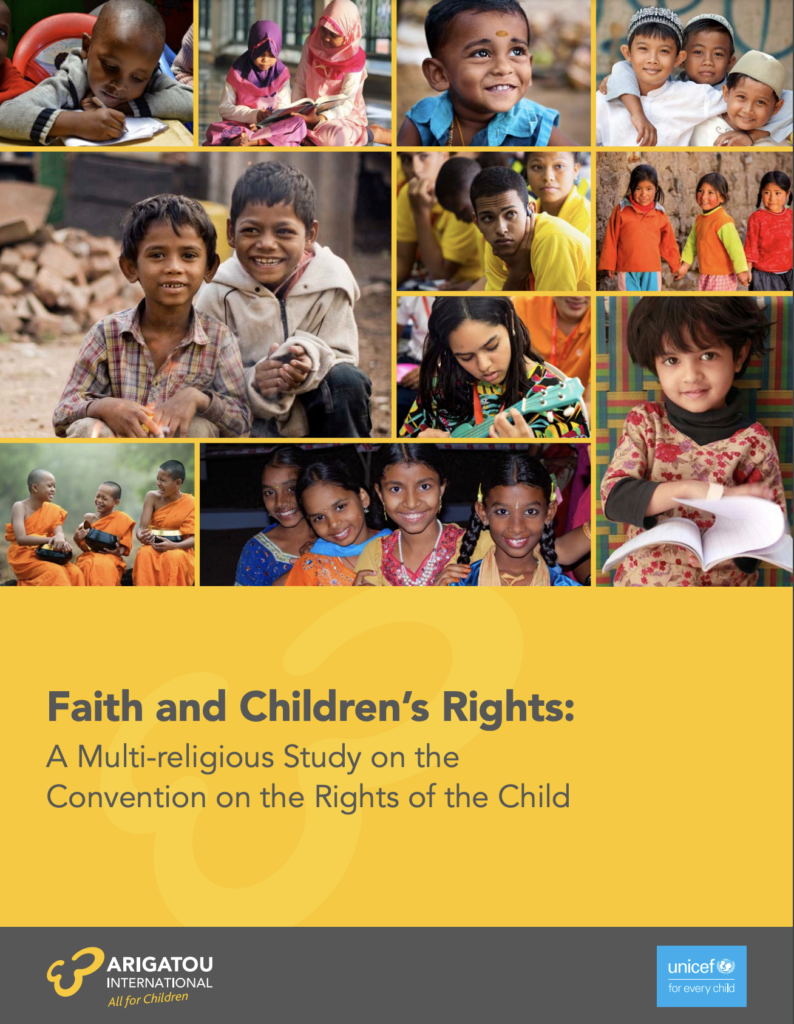
GNRC – UNICEF joint study project 

CHILDREN IN WORLD RELIGIONS

      Background
The joint GNRC – UNICEF project “Children in World Religions" is an undertaking under a PROJECT COOPERATION AGREEMENT between UNICEF, the United Nations Children's Fund, and the Global Network of Religions for Children (GNRC) signed on May 19th 2004 in Geneva. This agreement aims at researching and documenting resources on teachings, approaches, perspectives and practices in world religions vis-à-vis the individual child, children and young people.

Breif Project Description
The study project aims at assessing how the child, children and young people are portrayed in religious scriptures, are cared for, are ministered to and are treated in religious communities and how young people view themselves in their religious context. 

It involves experts, such as religious scholars within their own religious traditions and related fields, as well as educators and practitioners, including young people. They will be selected from major world religions, including Buddhism, Christianity, Islam, Judaism, Hinduism and Indigenous traditions. This selection is based on two criteria: contemporary demography and historical geographical spread. This choice is not comprehensive of the much broader diversity of religious traditions worldwide today, which a second phase of this project could address. 

This study seeks to examine how, over centuries, major world religions have developed their respective views on the child, including their rights and obligations, and how their communities (parents, family, educators, etc.) have internalized these norms. These norms will then be compared to those reflected in the Convention on the Rights of the Child (CRC), which is a fundamental scope of the study. Suggested foci of the study are: 

- freedom of expression, thought, conscience and religion 
- protection and education 
- health and access to clean physical and healthy environment 
- the child’s right to a name and nationality 
- participation and role as agents of change 

The study will provide information as well as tools and material addressing how religious communities relate to and can contribute to the implementation of the CRC.

The overall outcome is envisaged as both a resource and an advocacy tool for a multitude of constituencies, most importantly for religious communities, religious and faith based NGOs and for UNICEF country offices. Several products will emanate from the overall outcome, including a manual with information for advocacy initiatives, leaflets on specific issues and ideas for discourses on specific issues.

Rationale
Religious beliefs are central to the lives of most people worldwide. While the 1990 Princeton Declaration, the 1990 World Summit for Children Declaration and Plan of Action and the 2002 UN Special Session on Children present consensus for religious support of the CRC, it does not provide information about the understanding of specific perspectives of world religions on the child, children and young people.

The study is about harnessing the resources and outreach of religious communities in support of children and to empower religious leaders, practitioners and young people to better effect change for children and young people. It is also about creating greater harmony and understanding among religious traditions and will emphasize peace education, ethics and respect for diversit

Religious leaders and organizations have moral authority and power to influence families, communities and in many countries, even the political process. The results of this study can be used to increase both the involvement of each religious community in promoting the CRC within their respective institutions as well as help to develop a deeper rationale for inter-religious cooperation at a broader level, contributing to more harmonious, pluralistic societies. 

The
First Meeting of the Study team was held in May 2007 in Tokyo, Japan, to agree on a common approach to the study. After individual research and writing, the members of the study team meet for a Second Meeting in Florence, Italy in October 2007. The contributions from the team members were shared and discussed and the format for the outcome publication developed.

A Third Meeting of the Study team is scheduled to be held in Marrakech, Morocco in February 2008 and the results of the Joint Study will be released at the GNRC Third Forum in Hiroshima in May 2007.


For more details about the Joint Study, please contact

Dr. Patrice Brodeur 
Project Coordinator
Tel: + 1 514-343-2164
Email: patrice.brodeur@umontreal.ca

Ms. Agneta Ucko
Director – Arigatou International
Tel: + 41 79 509 79 23
Email: ucko@arigatou.ch