Interfaith Council on Ethics Education for Children
April 2005
Vision and Mission
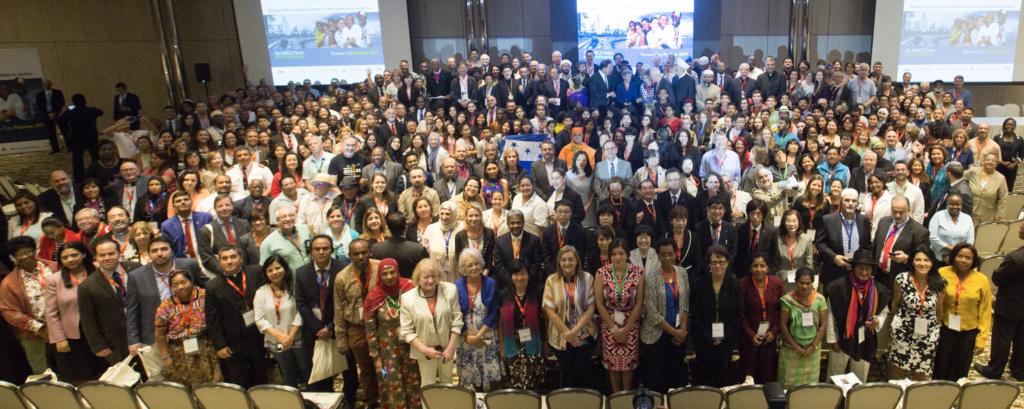
In May 2000, nearly 300 men and women representing seven major world religions from 33 countries and regions on every continent gathered in Tokyo, Japan to inaugurate the Global Network of Religions for Children (GNRC) at its First Forum, which was organized by the Arigatou Foundation. The objective in forming the GNRC was to make a new contribution to the well being of children from the religious perspective, through collaboration and cooperation among people of different religious engaged in activities for children. The GNRC is working to achieve this by cooperating, not only with religious people, but also with international agencies, governments, NGOs, scholars, business people, and men, women and children from all walks of life, in order to foster a global movement to create a better environment for children in the 21st century.
In the follow-up to the First Forum, the GNRC set its sights on realizing a fundamental solution to the problem of poverty, which is at the root of the many challenges children face, and to do so by working primarily in the field of education. Since then, GNRC members have organized workshops and conferences to work out specific action plans as well as establish interfaith networks in major world regions such as South Asia, Africa, Central Asia and the Caucasus, the Middle East, Europe, and Latin America inviting the participation of other people of faith from countries throughout these regions.
The international community has warmly welcomed these interfaith initiatives devoted specifically to children. On the occasion of the United Nations Special Session on Children in May 2002, Rev. Takeyasu Miyamoto, Leader of Myochikai and President of Arigatou Foundation, and inaugurator of the GNRC, was given the opportunity as an NGO speaker to make a statement on behalf of the GNRC to the plenary session of the United Nations General Assembly. He proposed three key actions for religious people to build a world truly fit for children. The first of these proposals called for the establishment of a “Council on Global Ethics Education for Children.”
After a series of preparatory meetings among GNRC members, experts in ethics and in education, representatives of UNICEF and UNESCO, and other concerned leaders and academics, the Interfaith Council on Ethics Education for Children was established, with the endorsement of Rev. Takeyasu Miyamoto on behalf of the GNRC, as formally announced at the Second Forum of the GNRC in Geneva, Switzerland in May 2004.
Rationale
Though the material prosperity that came with the advancement of science and technology has rapidly broadened the horizons of human activity, a global warning cry at the spiritual deterioration of humanity is long past due, especially in the field of ethics. Unceasing conflict and confusion, growing disparity between the rich and poor, and the decline of human compassion across all societies have gravely impacted the spirits of children, in particular, as they are subjected to many forms of unacceptable victimization. Sadly, even among children, the rate of serious crime is increasing in many places.
Not only these obviously dire circumstances, but also the more subtle globalization and diversification of human life in general have significantly altered the environment in which children live. The breadth of the child’s experience has expanded beyond the country or region in which the child lives to include information and influences from distant regions around the world, and this deeply affects the child’s being and development. Many children are no longer able to respond adequately to their reality by relying solely on traditional values and ethics that are limited to the scope of a particular society or region.
The desperate situation of the world’s children in both developing and developed nations demands the development and practice of ethics that take into greater account the interdependence of all societies, communities, and individuals. Such ethics by definition respect the respective traditional values and ethical foundations of different communities while simultaneously promoting the harmony and well being of the entire human family in all its diversity.
Indeed, at the 46th session of the International Conference on Education held by UNESCO in September 2001, the Argentine minister of education stated, “Education in the twenty-first century has a twofold mission: to teach about diversity and the problems of the human species and to help to raise awareness of the similarities and interdependence that exists among all human beings.”
The human being is inherently a social being - he or she can survive and grow only in relation to other people, society, the world, and nature. Therefore, constant concern for person-to-person or person-to-nature relationships - the process of giving careful regard to others, society, and nature - is essential for human living. At the deepest level, the essential nature of the human being is to “live thanks to others,” and this is the source of the duty and responsibility of every person to live “for others,” or to live in such a way that brings life to others. Thus, every person is meant to live both “for” and “thanks to” others. For a person to live a truly human life means nothing less than to live in full accordance with this essential, interconnected nature of humankind.
The human being is also unique in the capacity for existential thought, the ability to discover and construct ethical principles, and the free will to choose to behave in respect for those principles. Ethics in the 21st century must emphasize the value of the conscious choice to live a truly human life in community and solidarity with the entire global human family.
Children who grow up making this choice can change the world. Education in ethics for this global context can empower children - the inheritors of the earth and the promise of our future - to play a major role in creating a world of greater justice, peace and dignity. Indeed, education that fosters children’s spiritual development based on ethical values suited to today’s global context is a vital priority for the survival and growth of the human family.
Vision Statement
We envision a world in which all children are empowered to develop their spirituality - embracing ethical values, learning to live in solidarity with people of different religions and civilizations, and building faith in the Divine Presence. We believe that ethics education will enhance children’s innate ability to make positive contributions to the well being of their peers, families, and communities, and that this in turn will help the entire human family to thrive in an environment of greater justice, peace, compassion, hope and dignity.
Mission
The Interfaith Council promotes ethics education in cooperation with all sharing this vision, seeking partnerships and developing alliances with religious communities, United Nations agencies, NGOs, and a broad range of others in the effort to realize the right of the child to full and healthy physical, mental, spiritual, moral and social development and the right of the child to education set out in the Convention on the Rights of the Child.
The mission of the Interfaith Council is:
| ► | To advocate widespread implementation of education that offers children opportunities to develop their spirituality fully, in recognition of the rich spiritual resources that children themselves possess; |
|
|
| ► | To foster respect for people of different religions and civilizations among children; |
|
|
| ► | To promote appreciation of the vital role of children as equal partners in building a world based on ethical values and practices; |
|
|
| ► | To contribute to the safeguarding of human dignity, which is rooted in the infinite and unique value of every human life; |
|
- Respect for the dignity of human being of different religions, cultures and civilizations
- Affirmation of the right of the child to full and healthy physical, mental, spiritual, moral and social development and the right of the child to education, as set out in the Convention on the Rights of the Child
- Recognition that children are active participants in shaping their own ethical and spiritual development, and one of the primary actors in ethics education
- Importance of ethics learning at every stage and in every context of the child’s development, including the family, community, school, peer groups, and media, with priority placed on the vital early childhood years
- Inclusion of all children, and the need for special measures to reach those in poverty or other marginalized groups with opportunities for both basic and ethics education
- Unity of action on a global scale complemented by unique approaches created in each region and local area in advocating and implementing ethics education
- Cooperation with people of faith, regardless of religious tradition, in realizing the implementation of ethics education around the world
- Valuing cooperation with United Nations agencies, NGOs, governments, and a broad range of other organizations and people of good will
- Pursuing synergies with the various efforts for ethics education that are already underway around the world.
- Collaboration with efforts related to the Declaration Toward a Global Ethic issued by the Parliament of the World’s Religions in Chicago, U.S.A., in 1993.
Strategies
- Advocate ethics education as essential for the full implementation of the Convention on the Rights of the Child
- Raise public awareness of the need for ethics education around the world
- Encourage governments to adopt ethics education for children in their educational systems
- Build a network of organizations and individuals that conduct ethics education at all levels
- Identify and share model cases and best practices in ethics education among organizations and individuals that conduct ethics education
- Develop region- and location-specific action plans for promoting ethics education
- Work in cooperation with religious communities and others at the grassroots level to implement ethics education
- Develop tools for implementation of ethics education, including manuals for teaching ethics in schools and other settings such as the home and the religious community
- Monitor and evaluate cases of implementation of ethics education for children undertaken at the initiative of the Council
- Enhance children’s contributions to ethics education and assist children themselves to encourage their peers to participate in and promote ethics education
- Strive to shape the influence that the media have on children’s ethical and spiritual development
Role and Organization of the Interfaith Council
The role of the Interfaith Council on Ethics Education for Children is to serve as an international resource center and nexus for dialog, partnership and action on the theory and practice of ethics education for children. The Interfaith Council has been established at the initiative of the Global Network of Religions for Children (GNRC), with the support of the Arigatou Foundation. It will consist of a Council, a Committee forming various taskforces, and a Secretariat.
The Interfaith Council is composed of persons nominated by GNRCmembers in consideration of regional, gender, religious and professional balance and approved by the Arigatou Foundation. It will have at least one child member in all its constellations, i.e. in the Council, in the Committee as well as in each of its taskforces.
Responsibilities
The Interfaith Council will, as mandated by Rev. Takeyasu Miyamoto on behalf of the GNRC and guided by this Vision Statement and Mission,
- determine the overall direction for the promotion of ethics education.
- develop and revise overall strategy for promoting ethics education, monitor and evaluate cases of implementation.
- examine and make recommendations on various issues pertaining to the promotion of ethics education.
- advocate the implementation of ethics education for children around the world.
- issue an annual report with the endorsement of Rev. Takeyasu Miyamoto on behalf of the GNRC, on the activities of the Interfaith Council and ethics education around the world.
Council
The Council will convene once annually to review and recommend the overall direction of the ethics education initiative, issue a communiqué, statement or message and release the annual report on the progress of ethics education.
Committee
The committees will meet twice annually to address practical matters related to content and to strategies required for the promotion of ethics education. The Committee will form or divide into taskforces when necessary.
One of the meetings of the Committee may be held concurrently with the annual meeting of the Council. Meetings of the Interfaith Council in its different constellations will include joint sessions with GNRC Coordinators for the regions and other GNRC members.
Taskforces
Taskforces will be formed on an ad hoc basis at the initiative of the Committee and will carry out the specific tasks assigned to them. Initially, the following four taskforces will be formed.
| ► | Taskforce for Development of Ethics Education Tools and Materials This taskforce will be responsible for developing tools, guidebooks and manuals for the implementation of ethics education. |
| ► | Taskforce on Strategies for Promoting Ethics Education on the Regional and Local Levels This taskforce, which will include the GNRC coordinators, will be responsible for formulating and coordinating the implementation of ethics education projects and for developing action plans for promoting ethics education in regions and local areas |
| ► | Taskforce on Child Participation This taskforce, which will include the child members of the Interfaith Council, will be responsible for assisting children and young people to encourage their peers to participate in the promotion of ethics education and for enhancing children's contributions to the promotion of ethics education |
| ► | Taskforce on Media influence on Ethics Education This taskforce will be responsible for finding ways to approach journalists and media to enhance the awareness on media's role in transmitting values and promoting ethics education |
The secretariat of the Interfaith Council on Ethics Education for Children has been established in Geneva under the umbrella of the Arigatou Foundation, and a secretary general and administrative staff will support the activities of the Council, Committee, and its taskforces. The Council Secretariat will plan, budget and implement the meetings of the Interfaith Council in its various forms.
The Council Secretariat will also create and maintain a database of organizations that conduct ethics education including model cases and best practices in ethics education and establish a network of organizations and individuals that conduct ethics education. The Council Secretariat will, in consultation with GNRC Coordinatiors, draft the annual report on the activities of the Interfaith Council and the status of ethics education around the world.
Finances
The Arigatou Foundation will financially support meetings and activities recommended, initiated and undertaken by the Interfaith Council on Ethics Education for Children.
The Council Secretariat will submit a budget request for the meetings and recommended activities to the Arigatou Foundation for consideration and decision/approval by the Board of Directors of the Arigatou Foundation.
Organization Charts